Free tool
WhatsApp UTM builder
Build the link with utm_source, utm_medium and utm_campaign in seconds. Then you will know which campaign brought each sale, not just how many clicks it got.
Your store, your landing page or the link that opens the chat. If you skip https://, we add it.
Shortcuts
The exact platform: meta-ads, instagram, tiktok, google.
Paid or not: cpc, paid-social, organic-social, email, bio.
The name you recognize in your report.
Useful to tell ad sets or audiences apart.
So you know which ad or button converted.
Fill in the URL, source, medium and campaign to build your link.
How to use it
- 1
Paste the URL you want to send people to and pick a shortcut, or write your own parameters.
- 2
Copy the link with UTMs and use it in your ad, your Instagram bio or your WhatsApp campaign.
- 3
Check your reports to see which campaign brought conversations and which ones ended in a paid order.
Why attribution matters more on WhatsApp than on any other channel
On your site, Analytics tells you where every visit came from. On WhatsApp the conversation starts and the trail goes cold: you see 40 new chats and no idea which ad paid for them. Without that you are not optimizing, you are guessing.
You stop splitting budget blind
With the campaign tagged you know which one brings chats that end in an order and which one only brings browsers. Only then is moving budget a decision instead of a hunch.
You can actually run experiments
Two creatives with the same utm_campaign and a different utm_content tell you which one sold. Without that, every test ends in “it felt like it worked”.
Often the campaign isn't the problem
Sometimes the campaign does sell and you never find out, because the sale closed in a chat nobody attributed. Measuring badly looks a lot like selling little.
WhatsApp link generator
Build a wa.me link with your number in seconds. Drop it in Instagram, web or ads.
Once you are measuring
Your Meta campaigns and your WhatsApp sales, inside yavendió!
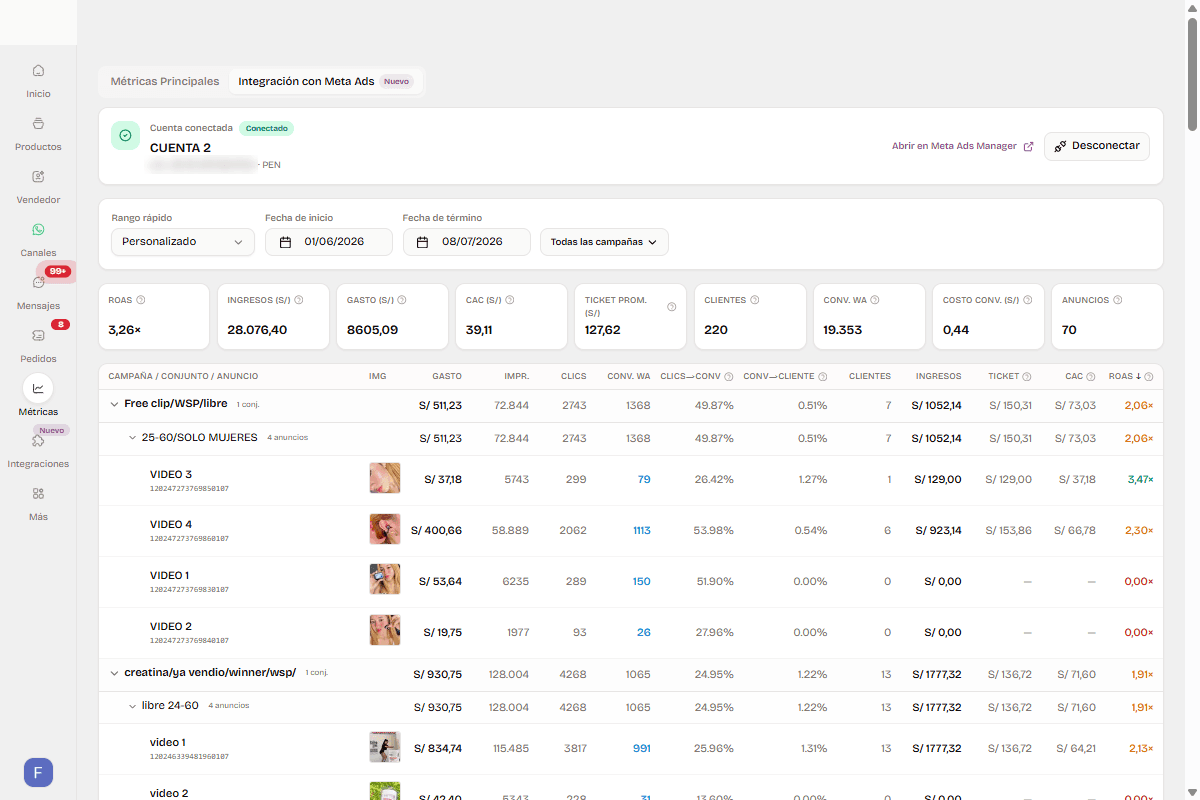
Connect your ad account and yavendió! shows you, inside Metrics, which Facebook and Instagram campaigns drive the most WhatsApp sales: spend, ROAS and conversations in one place. The UTM tells you where the chat came from; this tells you what it cost and what it returned.
With yavendió!
The link is half of it. The other half is storing where each conversation came from.
WhatsApp Business doesn't keep the UTM: the customer messages you and that data is gone by the greeting. With yavendió! every conversation keeps its origin, so you see which campaign generated which chats, which orders and how much revenue — and you decide where to invest next month with numbers, not intuition.
FAQ about UTMs and WhatsApp
What is a UTM and what is it for?
A UTM is a tag added to the end of a link to record where each visit came from. There are five parameters: utm_source (the platform), utm_medium (the traffic type), utm_campaign (the campaign) and, optionally, utm_term and utm_content. They tell you which ad, post or email brought each person.
Can you measure WhatsApp campaigns with UTMs?
Yes, with one condition: something has to store the UTM at click time and attach it to the conversation. The tagged link is the first step; without a platform that records that origin, the data is lost the moment the chat opens.
Why doesn't WhatsApp Business tell me where each chat came from?
Because the WhatsApp Business app only receives the message, not the browsing history of whoever wrote it. You see the number and the text, nothing else. Linking each conversation to the campaign that generated it needs a platform that captures that origin at click time.
Which utm_source and utm_medium should I use for WhatsApp?
The most common convention is utm_source=whatsapp with utm_medium=social for organic messages, and utm_source=meta-ads with utm_medium=cpc when the click comes from a paid ad. What matters is picking a convention and sticking to it: UTMs are case-sensitive, so “Meta Ads” and “meta-ads” split the same campaign into two rows in your report.
Does it work for Meta's click-to-WhatsApp ads?
For those ads Meta sends its own ad reference along with the message, so attribution doesn't depend on the UTM. The builder still helps everywhere else: your Instagram bio, email campaigns, organic posts and any link that goes to your store.